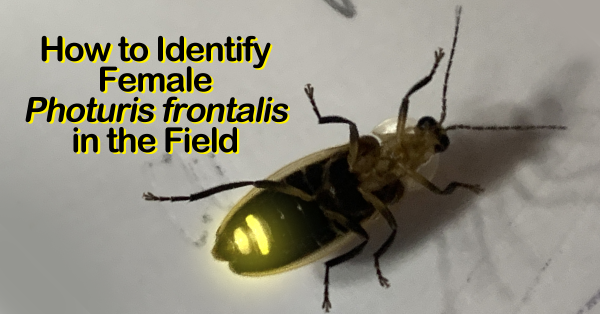
Where to look, what their flashes look like, and how to tell them apart from other fireflies
Female Photuris frontalis are rarely observed because they behave very differently from the males. Males fly and flash in synchronous displays. Females usually stay low in vegetation. They flash faintly or remain dark for long periods. Finding them requires searching along wooded edges, scanning close to the ground, and investigating faint or unusual flashes.
Field Identification Summary (Female Photuris frontalis)
Look for these traits:
- Lantern composed of two bright lateral segments
- Smaller eyes than the males
- Stationary posture during signaling
- Located low in vegetation or near ground
- Responds to male flashes with delayed answering glow
Female Photuris frontalis are easy to miss.
That’s the whole problem.
The males are obvious. They fly, flash, and form the synchronous displays that make this species famous. The females usually behave very differently. They stay low, flash faintly, and often remain dark for long stretches.
If you watch the air instead of the ground, you can walk right past them. You might never know they were there.
Between 2023 and 2025, I confirmed eight female Photuris frontalis on my property in southeast Louisiana. Most were found low to the ground along wooded edges rather than out in the open with the males.
If you want to find female “Snappies” (the common nickname for Photuris frontalis), you need to change how you search.
The short version:
- Look along habitat edges
- Look low to the ground
- Watch for faint, unusual flashes
- Pay attention when males suddenly dip or hover
- Confirm the ID by examining the lanterns
Everything else is patience.
Start by Looking in the Right Place
Location matters.
On my property, the most productive areas are where open yard meets underbrush. That includes:
- wooded edges
- driveway borders
- leaf litter
- low stems and small plants
Most confirmed females appeared in these transition zones.
Instead of staring at the flashing swarm of males, look at the border where grass meets debris. Focus also on where plants hang over leaf litter.
That is often where the interesting things happen.
In one 2025 observation, I saw a female sitting in leaf litter beneath an elderberry. A male flew toward her, and both went dark in the leaves.
Look Low—Then Lower
This may be the single most useful piece of advice.
Look close to the ground.
My confirmed females have appeared anywhere from ground level to about three feet, but most were much lower than that. Several were only inches above the ground or resting directly in leaf litter.
One perched about six inches up on a small pine sapling. Another flew and faintly flashed only about three inches above the ground.
Most sightings occur within a foot of the ground.
If your eyes stay trained at the height where males are flying, you will miss many females.
Female Snappies demand slow searching and attention to the vegetation near your feet.
They also demand the kind of patience that occasionally makes you question your life choices.
Don’t Dismiss the First “Maybe”
Female flashes are easy to doubt.
Often the first sign is a faint, odd little flicker. It makes you wonder if your eyes are playing tricks on you.
In many cases, that faint flash is exactly what leads to the female.
Sometimes the flash comes from a twig. Sometimes from leaf litter. Sometimes it appears once and then disappears long enough that the spot looks empty.
One female I documented in 2024 was hiding about six inches beneath dewberry bushes. I saw a faint flash and almost kept walking. When I glanced back, it flashed again.
After she stopped flashing, I used a headlamp to relocate her among the stems.
If you think you saw something unusual, stop. Watch the same spot again.
Females often flash infrequently, and that sparse behavior is part of what makes them so easy to overlook.
What the Female Flash Looks Like
The exact flash pattern of female Photuris frontalis is still being studied.
From repeated observation, it appears:
- faint
- irregular
- much less showy than the male display
In one observation, the female produced quick double-flash sequences containing roughly four to eight flashes. In other cases she flashed once, went dark, or responded faintly when males approached.
Rather than memorizing a strict flash pattern, a better rule is simple:
Investigate faint flashes that appear low in vegetation after males are already active.
Many of the females in my observations were first noticed. The flash seemed slightly “off” compared with the normal male display.
Watch What the Males Do
Sometimes the males reveal the female.
I have seen males suddenly dip toward the ground. They hover around one patch of vegetation. They may also fly directly toward a female sitting in leaf litter.
In one observation, a male approached a female in the underbrush. The two flashed back and forth. They then disappeared into the leaves.
If a male suddenly shows interest in one small area near the ground, it is worth watching closely.
The Best Way to Confirm One: Look at the Lanterns
Flash behavior can mislead.
Lantern structure is much more reliable.
When I suspect a female, I gently capture the insect. I then inspect the lanterns. They are the light-producing segments on the underside of the abdomen.
In my experience:

Male Photuris frontalis
noticeably large eyes
two large lanterns

Female Photuris frontalis
smaller eyes
two smaller, segmented lanterns


Lantern structure has been the most dependable way to confirm identification.
The Biggest Source of False Hope: Femme Fatales
If you search for female Snappies long enough, you will get fooled.


Photuris “femme fatale” species in the versicolor group mimic the flashes of other fireflies to lure males. They often sit in grass or on stems and flash irregularly, which can look very similar to a female P. frontalis.
Once examined closely, however, the differences become clearer. Femme fatales usually show larger lanterns and more color in the hood.
Larvae can also fool you.
In one 2025 observation, a faint glow in the grass near an elderberry looked promising. However, a headlamp revealed a firefly larva instead.
The woods do occasionally enjoy mocking us.
Weather Matters
Weather affects both activity and visibility.
Rain and wind tend to suppress firefly activity and make flashes harder to interpret. Many female observations occurred on warm, humid evenings with lighter wind after male activity was already underway.
A Simple Search Method
My routine is straightforward:
- Walk slowly along habitat edges.
- Stop often.
- Ignore most flying males.
- Scan low plants and leaf litter.
- Investigate faint flashes near the ground.
- Watch for males dipping toward specific spots.
If a suspected female stops flashing, a headlamp can help relocate her among stems and leaf litter.
Patience Matters
So far I have confirmed eight females, with several additional suspects that vanished after going dark.
They are not impossible to find.
But they are not eager to be found either.
Patience matters more than luck—and more than any theory about flash patterns.
A Final Note
Females appear less numerous. They are still being actively studied. Therefore, they should be handled gently. Handle them only when necessary for identification or documentation.
Female Photuris frontalis are not impossible to find.
But they reward patience, attention, and restraint far more than enthusiasm alone.
These observations are based on repeated field documentation of Photuris frontalis in Southeast Louisiana. Continued observations will refine these identification traits.